

Blog
Why to choose a better front IP66 rated Panel PC?
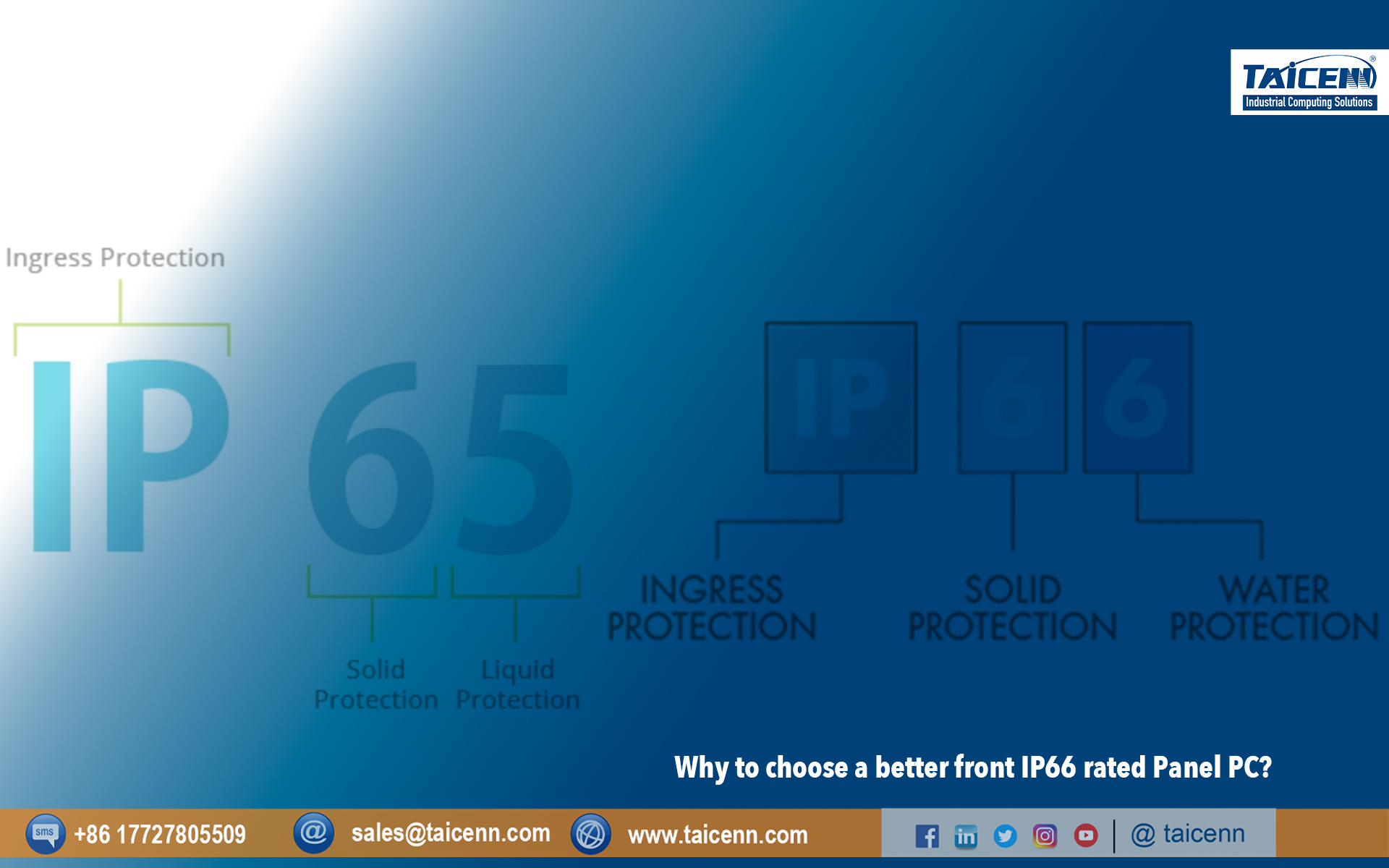
What IP65 & IP66 means:
IP65 means the enclosure is fully dust-tight and protected against water jets. It is a strong choice for environments where dust is present and the enclosure may face rain, splashing water, or routine hose spray, but not more demanding jet conditions. IP65 is not the better choice when the enclosure faces more severe or repeated high-intensity water-jet conditions.
IP66 means the enclosure is fully dust-tight and protected against more severe water-jet exposure than IP65. It is used where the enclosure may face stronger spray, heavier washdown, or harsher outdoor water conditions. IP66 improves water-jet protection, but it is still not an immersion rating. If submersion is possible, a different rating such as IP67 or IP68 may be needed.
Typical Applications & Costs:
The main difference between IP65 and IP66 is water-jet severity. Both ratings are fully dust-tight, but IP65 is designed for standard water-jet exposure, while IP66 is designed for more severe water-jet conditions.
Simple Applications Rule: Choose IP65 for normal outdoor spray and dust exposure. Choose IP66 when water-jet exposure is stronger, more frequent, or less predictable.
IP65 and IP66 often look close in specification, but the cost difference should be judged against the actual water risk. IP65 is often the more cost-effective choice for general outdoor and light industrial use. IP66 is often worth the premium when the enclosure faces more aggressive washdown or severe spray conditions.
Better Cost Suggestion: Choosing IP66 where IP65 is already enough may increase cost without adding practical value. Choosing IP65 where stronger jet protection is needed may lead to maintenance issues, downtime, or shorter enclosure life.
The best choice is not the higher number by default. It is the rating that fits the real installation environment.
How to choose between IP65 and IP66?
In industrial and outdoor application, we usually make a decision via three paths.
-Water Exposure
Rain, splashing water, or normal hose spray → IP65 may be enough
Stronger washdown, repeated jet cleaning, or harsher spray conditions → choose IP66
-Installation Environment
Sheltered outdoor or moderately wet industrial areas → IP65 may be suitable
Food processing, marine, or harsher industrial exposure → IP66 is often safer
-Maintenance Risk
If water ingress would be inconvenient but manageable, IP65 may work
If water-related failure would cause costly downtime or repeated service calls, IP66 is usually the better choice.
What Taicenn do?
In Taicenn company, All our HMI Panel PCs & monitors features a structural design to withstand rigorous and demanding industrial environment. We designs our full range HMI Panel PCs & monitor with front IP66 rated, and expect to cover and meet more rugged and critical applications.
Taicenn’s greatest advantage is to deliver full ranges & CPU platforms, modular concept designed and manufactured Industrial Panel PCs and monitors. All series products are inventory from 10.1” to 23.8” dimensions, same cut-out dimension on both Pcap. & resistive touch options, wide CPU platform ranges to support newest Intel Core Ultra, advanced, flexible & capable customized service.
Conclusion:
The main difference between IP65 and IP66 is the severity of water-jet protection, not dust protection. If the enclosure will face normal rain, dust, and general outdoor spray, IP65 is often enough. If the environment includes more demanding washdown, stronger jets, or harsher outdoor water exposure, IP66 is usually the better choice. The best decision comes from matching the rating to the real site conditions, not simply choosing the higher number.