

Blog
What is the difference between 2.5GbE and GbE
In modern home, small-medium-sized enterprise and industrial networks, the specifications of the network interface directly determine data transmission efficiency. Traditional Gigabit Ethernet ports have been in use for years, and many users are accustomed to them. However, with increasing bandwidth and the prevalence of high-performance devices, 2.5G Ethernet ports are gradually appearing on more and more motherboards, routers, NAS, and switches.
So, what are the advantages of 2.5G Ethernet ports over Gigabit Ethernet ports? Is it worth upgrading? Are the two compatibles? What are the benefits of using 2.5G Ethernet ports?
What is Gigabit Ethernets and 2.5G ethernet ports?
| Gigabit Ethernet | 2.5G Ethernet | |
| Speed | Max. 1 Gbps (1000Mbps) | Max. 2.5Gbps (2500Mbps) |
| Connector type | Standard RJ45 connector | Standard RJ45 connector |
| Wiring Requirement | CAT5e or higher cables are required for full speed | CAT5e or higher cables are required for full speed |
| Common application | Home routers, motherboards, laptops, switches, etc. | High-end routers, NAS storage, gaming motherboards, and office switching equipment. |
To sum up: the 2.5G network port is an upgraded version of the Gigabit interface. The interface shape remains unchanged, but the speed is increased by 2.5 times.
Technical performance comparison
| Comparison | 1GbE | 2.5 GbE |
| Max. bandwidth | 1000Mbps | 2500Mbps |
| Actual transmission speed | Around 100~120MB/s | Aroud 280~300MB/s |
| Connector compatibility | Standard RJ45 | Same RJ45 (Backward compatible) |
| Network Cable support | CAT5e, CAT6 | CAT5e can full speed |
| Heat Power consumption | Low | A bit higher, but stable |
| Cost | Low | A bit higher, need the support from mainboard and route |
| Applications | General internet access, HD video streaming | Multi-device high-speed transmission, large file sharing, NAS, industrial applications |
Application scenario analysis: Who is more suitable for 2.5G network port?
If you’re just browsing the web, watching short videos, and holding online video conferences, a Gigabit Ethernet port is perfectly adequate.
However, for small and medium-sized enterprises and industrial applications, deploying a 2.5G network can significantly accelerate network data transmission, double the efficiency of NAS storage, network printing, and industrial protocols, and enable smoother bandwidth-intensive applications like video surveillance and HD video conferencing.
Future Trends: Is it Worth Buying 2.5G Now?
With home broadband speeds continuously evolving towards gigabit and beyond, many users are already using 2000Mbps fiber optic network. Furthermore, the price of 2.5G devices is gradually decreasing, and most mainstream mainboards now come standard with 2.5G interfaces. In the next 3~5 years, 2.5G will become the new mainstream.
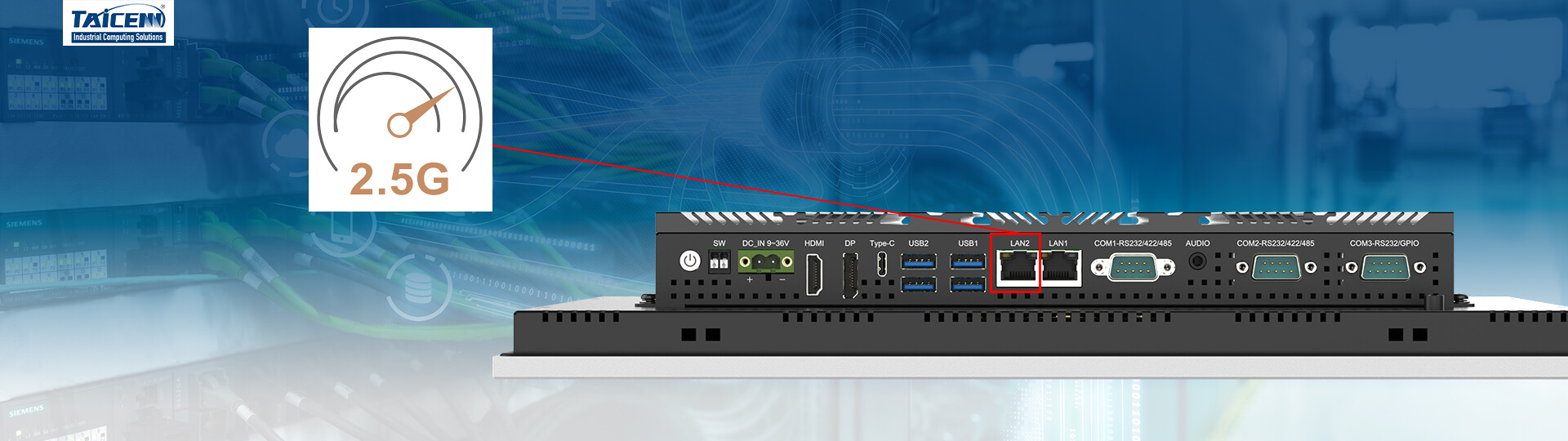
At the moment, Taicenn is delivering our newest industrial computing solutions to support 2.5G network. Whether it is an industrial Box PC or an all-in-one Panel PC, Taicenn latest series of products TPC-DCT&DRT D series and TBOX-2Dx8 equipped with Intel 12th Alder Lake Core i3/i5/i7 processors, and provide one 2.5GbE network port, providing a one-stop solution for various industrial and automation application projects.